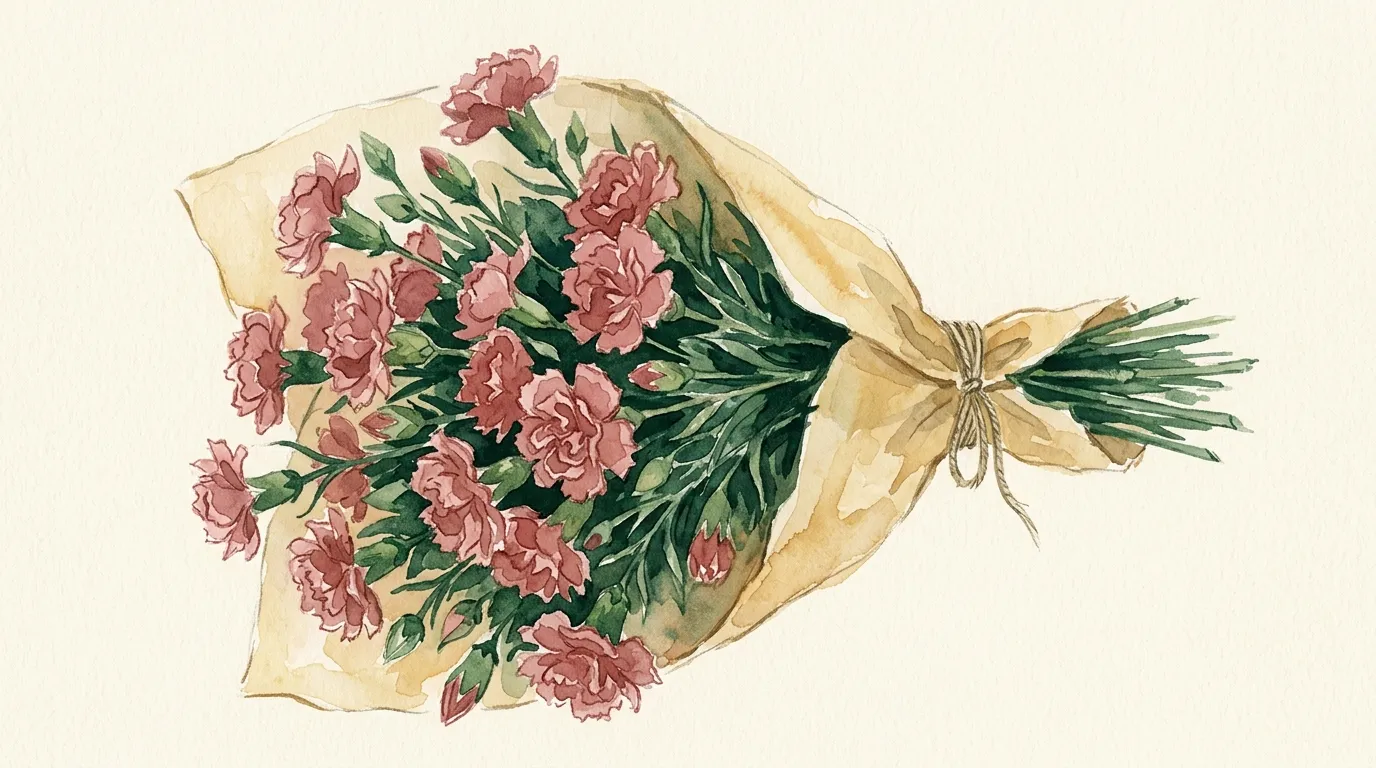
Carnation
Carnations: meaning by colour, vase life and value
Carnations last two to three weeks and cost less than anything else in the shop, which is why florists use them and buyers dismiss them. Colours and care.
Checked on
In season in Ireland
- January: out of season
- February: out of season
- March: out of season
- April: out of season
- May: out of season
- June: out of season
- July: out of season
- August: out of season
- September: out of season
- October: out of season
- November: out of season
- December: out of season
Not grown in season in Ireland
- Traditionally means
- Affection, with pink standing for a mother's love and red for admiration in the tradition most often quoted
- Vase life
- About 16 days
- Grown in Ireland
- No, imported
- Care in one line
- Cut between the nodes rather than through one, keep them cool, and change the water every third day
- Botanical name
- Dianthus caryophyllus
Carnations give more days in a vase per euro than any other flower sold in Ireland. Two weeks is ordinary and three happens regularly, at a price that undercuts everything except chrysanthemums. Florists know this, which is why carnations are in so much of the work they sell and so rarely on the front of the website.
The flower's reputation in Ireland is stuck somewhere around 1985, filling out a garage forecourt bunch beside a spray of gypsophila. That is a memory of how they were arranged, not a judgement on the flower.
What carnations mean
Affection, broadly, with the colours doing the specific work.
- Pink carries a mother's love, and this is the meaning behind the carnation's place in Mother's Day traditions.
- Red is admiration, deep red closer to love.
- White is pure affection and good luck, and in Irish and British funeral work white carnations are standard in wreaths and sprays.
- Yellow meant rejection or disappointment in the Victorian language of flowers, which is trivia rather than a live convention, though it is quoted often enough to give a florist pause.
- Striped meant refusal in the same Victorian lists. Nobody alive reads them that way.
The carnation is also the flower of remembrance for several political traditions in Europe, most visibly in Portugal, where red carnations mark the 1974 revolution. That does not carry any weight in Ireland.
Season in Ireland
There is no Irish carnation season. The cut flower trade grows them in Colombia, Kenya, Turkey and Dutch glasshouses, and the supply is level every week of the year, which is part of why the price never moves much either.
Garden pinks, the smaller scented relatives, do grow in Irish gardens through June and July, and they are a different proposition: short stems, real clove scent, and a week in a small vase. If someone offers you those from a garden, take them.
When to send them, and when not to
Carnations are the right answer when the flowers have to last: a hospital stay, a nursing home, an office reception, a house where nobody is going to be attentive about vase water. A bunch that still looks well after two weeks does more for the person receiving it than one that peaks on day three.
They also suit sympathy work in Ireland, where they are standard in wreaths and sprays and where longevity is a practical virtue.
Do not send carnations alone as a romantic gesture, not because of any meaning but because of what the flower signals here about how much thought went in. Do not use the very cheap dyed ones for anything that matters. And if you want scent, look elsewhere: most modern carnations have had it bred out in favour of transport tolerance, and freesias or sweet pea will do what you want instead.
Care
Look at the stem before you cut. A carnation stem has swollen joints at intervals, and a cut through one of those nodes takes up water badly. Cut in the gap between two nodes, on a slant.
Strip the lower leaves and keep the water shallow to medium. Carnations are not heavy drinkers.
They are unusually sensitive to ethylene, the gas ripening fruit gives off. A bowl of bananas on the same table will close the buds and shorten the flowers by days. Move one or the other.
Change the water every third day rather than every second: the stems are clean and the water lasts. Pinch off spent flowers on a spray carnation and the remaining buds keep opening, which is where the third week comes from.
Cool matters more than anything else. A hall or a north-facing room will get you a fortnight without much effort. See the vase life by flower table for how far ahead of the rest that is.
When to send them
Ordering carnation delivered in Ireland is a question of who reaches the address and by when, not of who stocks the stem: most services build to a style rather than to a single flower, so ask before you pay if it has to be this one.
Questions people ask
How long do carnations last in a vase?
Why are carnations seen as a cheap flower?
Where should you cut a carnation stem?
Are carnations toxic to cats?
What do dyed blue and rainbow carnations mean?
Read next
- Alstroemeria: two weeks in a vase, meaning and careAlstroemeria gives a fortnight for supermarket money and is why bouquets look alive on day ten. The meaning, the leaf trick, and the florist skin warning.
- Chrysanthemums: meaning in Ireland and across EuropeFine as a gift in Ireland, strictly for graves in France and Italy. What chrysanthemums mean where, the autumn season, and why they outlast everything.
- Vase life by flower: a reference tableRealistic days in a vase for 15 common flowers, from carnations at 14 plus down to sweet pea at 4 to 5, each with the one care note that changes the number.
- Mother's Day flowers in IrelandIrish Mother's Day moves every year because it tracks Lent. The rule, the next four dates, the ordering deadline, and what runs out first.