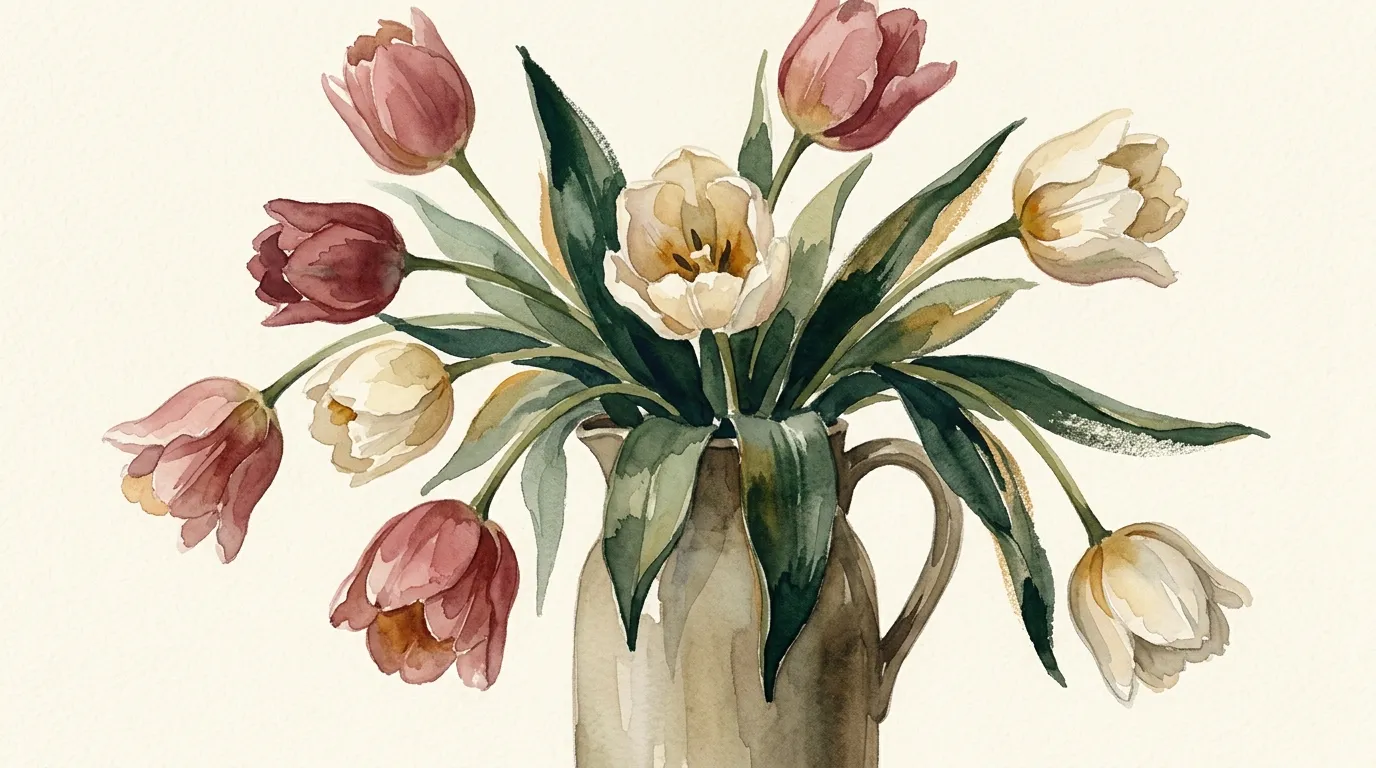
Tulip
Tulips: season in Ireland, meaning and vase care
Tulips keep growing after you cut them, bend towards the light and hate deep water. The Irish season, what the colours mean, and how to keep them upright.
Checked on
In season in Ireland
- January: out of season
- February: in season
- March: in season
- April: in season
- May: in season
- June: out of season
- July: out of season
- August: out of season
- September: out of season
- October: out of season
- November: out of season
- December: out of season
February to May
- Traditionally means
- Declared love in the older tradition, and in current use simply the arrival of spring
- Vase life
- About 6 days
- Grown in Ireland
- Yes, commercially
- Care in one line
- Shallow cool water, about 5cm, a straight cut across the stem, and a spot away from the window they will lean into
- Botanical name
- Tulipa
A cut tulip is not finished growing. It lengthens by up to 5cm in the vase, turns towards whatever light is nearest, and opens and closes with the temperature of the room. Florists treat that as the point of the flower rather than a fault, which is the right way to look at it: no other cut flower moves.
It also means a tulip arrangement is never quite the arrangement you made. If that matters, put them in a vase tall enough to hold the stems and let them do it.
What tulips mean
The formal meaning is a declaration of love, red tulips most of all, which puts them a step below the red rose and a step above almost everything else. Yellow tulips meant hopeless love in the Victorian language of flowers and now read as cheerfulness, a reversal complete enough that only the modern reading is in general use. Purple carried an association with royalty. Variegated or feathered tulips were once the most expensive flowers in Europe, a result of a virus rather than breeding, and the Dutch speculation around them in the 1630s is where most tulip trivia comes from.
None of this is heavy. In Ireland a bunch of tulips reads as spring, a house-warming, a thank you, or an apology of moderate size.
Season in Ireland
Tulips are one of the few flowers where the Irish season and the shop season overlap properly. Dutch glasshouse stock appears from November and runs to April. Irish growers force tulips under glass for the same trade, and a few flower farms cut them outdoors in April and May, which is when the stems are thicker and the colours are less uniform.
March is the month to buy them here. Irish Mother's Day falls on the fourth Sunday of Lent, so it lands in March every year, and tulips are at their cheapest and their best in exactly that week. A bunch of tulips in March costs a fraction of what roses cost in February and looks like more.
When to send them, and when not to
Send tulips for anything in spring: Mother's Day, a new house, a new baby, a recovery, an apology. They are informal in a way roses are not, which suits most of those.
Do not send them where nobody will be home for a few days. Tulips arrive tight and open fast in a warm room, and they are the wrong flower for an office desk on a Friday. They are also a poor choice for a formal sympathy arrangement, being too spring-like and too short-lived for a week of callers. And do not send them expecting a fortnight: six days is a normal life and eight is a good one.
Care that actually changes the outcome
Cut straight across rather than on a slant. A tulip stem is soft and a long diagonal cut collapses against the bottom of the vase.
Then keep the water shallow, around 5cm, and cold. This is the opposite of the advice for most flowers and it is the single thing that keeps tulips standing. A tulip stem left in deep water softens along its whole submerged length and folds. Top up daily rather than filling the vase.
Strip the leaves below the water line. Tulip leaves are broad and rot quickly, and the slime that results blocks the stems within two days.
Do not add them to a vase of daffodils straight from the shop. Daffodil sap blocks a tulip's water uptake and will halve its life. Condition the daffodils on their own for six hours first, then combine without re-cutting them.
If the heads flop on day one, that is thirst rather than the end. Re-cut the stems, roll the whole bunch tightly in newspaper so the necks are supported to the top, and stand it in deep cool water for an hour. Take the paper off and they will be upright. This trick works once or twice, not five times.
A cool room does the rest. Tulips last noticeably longer in a hall than in a heated sitting room, and a night in an unheated room buys you a day.
When to send them
Ordering tulip delivered in Ireland is a question of who reaches the address and by when, not of who stocks the stem: most services build to a style rather than to a single flower, so ask before you pay if it has to be this one.
Questions people ask
Why do my tulips flop over in the vase?
Do tulips really keep growing in the vase?
Can you put tulips and daffodils in the same vase?
Are tulips grown in Ireland?
Read next
- Daffodils: Irish season, meaning and the sap problemDaffodil sap kills the other flowers in a mixed vase unless you condition them alone first. The Irish season, Daffodil Day, and the folk superstition.
- Freesias: the scent, the spring season and careThe most scented flower in an Irish shop for under 10 euro, and the one that opens bud by bud. What freesias mean, when they are cheapest, how to hold them.
- Irish flowers in season: a month-by-month calendarWhat Irish growers genuinely cut in each month, January to December, in one table: snowdrops in January, peonies in June, dahlias to the first frost.
- Mother's Day flowers in IrelandIrish Mother's Day moves every year because it tracks Lent. The rule, the next four dates, the ordering deadline, and what runs out first.