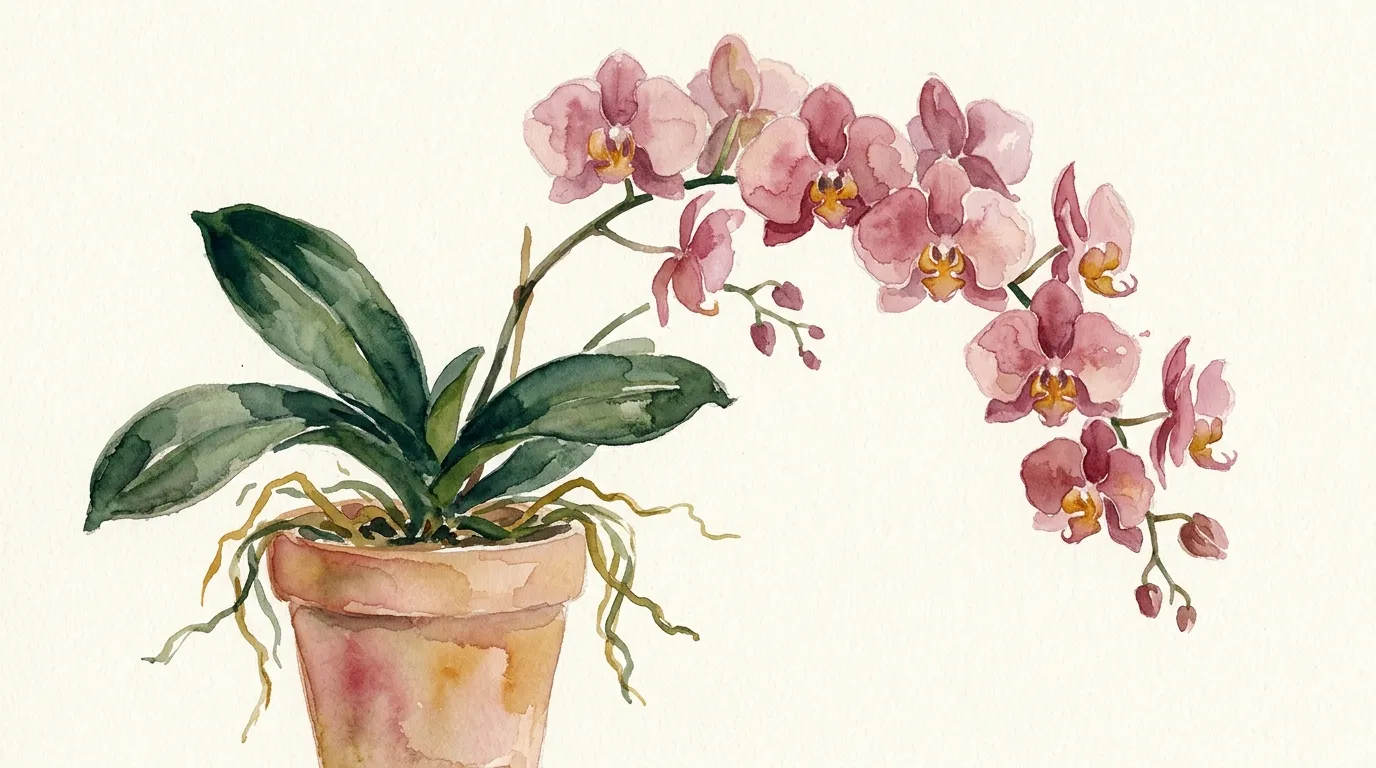
Orchid
Orchids: cut stems, pot plants, meaning and care
A 15 euro potted orchid outlives a 60 euro bouquet by months. What orchids mean, what cut orchids actually cost to keep, and the watering mistake.
Checked on
In season in Ireland
- January: out of season
- February: out of season
- March: out of season
- April: out of season
- May: out of season
- June: out of season
- July: out of season
- August: out of season
- September: out of season
- October: out of season
- November: out of season
- December: out of season
Not grown in season in Ireland
- Traditionally means
- Refinement and rare beauty in western usage, and fertility and many children in the older Chinese tradition
- Vase life
- About 18 days
- Grown in Ireland
- No, imported
- Care in one line
- Cut stems want shallow clean water and no draught; a pot plant wants a weekly soak, drained, and no saucer of standing water
- Botanical name
- Phalaenopsis, Cymbidium and Dendrobium
A potted phalaenopsis costs about 15 euro in an Irish supermarket and flowers for two to four months. A delivered bouquet costs 40 to 70 euro and is finished inside a fortnight. If the gift is meant to last, that comparison is the most useful thing on this page, and it is not one a flower shop is going to put in front of you.
Cut orchids are a different product with a different job: sprays of cymbidium or dendrobium in arrangements and bridal work, at a price per stem that reflects how long they take to grow.
What orchids mean
In western florist usage the orchid stands for refinement, rare beauty and luxury, a meaning that dates from the Victorian collecting mania when a single new species could be worth a house. The Victorian language of flowers listed the orchid as beauty and a refined kind of love.
The older and more specific tradition is Chinese, where the orchid is one of the four gentlemen alongside plum, bamboo and chrysanthemum, standing for integrity and quiet nobility, and where it carries an association with fertility and children.
Colour meanings here are modern florist convention rather than tradition: white for elegance, pink for affection, purple for admiration. Nobody receiving an orchid decodes it. What an orchid says in Ireland is that the sender spent money and expected the gift to sit in a room for a long time.
Season in Ireland
There is no Irish season, and no meaningful Irish production. Cut orchids arrive from Thailand and Singapore by air or from Dutch glasshouses by lorry, in the same volumes every week of the year. Potted phalaenopsis come from large Dutch and German nurseries.
Ireland does have wild orchids, and they are worth knowing about even though they have nothing to do with the shop. Bee orchids, marsh orchids and pyramidal orchids grow in dune systems and on limestone grassland including the Burren, flowering from May to July. Every one of them is protected in the sense that picking or lifting them destroys a slow-growing plant. Photograph them and leave them.
When to send them, and when not to
Orchids suit a milestone: a retirement, a significant birthday, a new house, a thank you that needs to be substantial. A potted plant is the better version of that gift in nearly every case.
They suit Mother's Day for the same reason, with one practical advantage: Irish Mother's Day falls in March, and a pot bought that week is still flowering at the start of summer.
Cut orchids are worth the money in bridal work, where a few stems do the work of many. As a general rule for a wedding budget, a small number of orchid stems in the bridal bouquet with cheaper flowers elsewhere is a more efficient spend than orchids on every table.
Do not send them for sympathy in Ireland. The flower is too showy for a funeral home and the family will have nowhere to put a pot plant. Do not send a pot to someone who travels constantly, since three weeks with no water in a warm flat will finish it.
Care
For cut stems: cut 2cm off on a slant, use shallow clean water with the sachet, and keep them away from draughts, radiators and open windows. Orchid flowers are thin-textured and dry out at the edges before the stem gives up. Change the water every third day.
For a pot: the two things that kill them are cold and standing water. Take the clear inner pot to the sink once a week, run tepid water through the bark for a minute, let it drain fully, then put it back in the outer pot with nothing in the bottom. Bright indirect light, no direct sun on the leaves, and a room that does not drop below 15C.
When flowering stops, cut the spike back to just above a node and keep going. A phalaenopsis that gets a weekly soak and a bright windowsill out of the midday sun will flower again, and again after that.
When to send them
Ordering orchid delivered in Ireland is a question of who reaches the address and by when, not of who stocks the stem: most services build to a style rather than to a single flower, so ask before you pay if it has to be this one.
Questions people ask
Are orchids grown in Ireland?
How long do cut orchids last?
Should I water an orchid with ice cubes?
My orchid dropped all its flowers. Is it dead?
Are orchids safe around cats?
Read next
- Lilies: meaning, season in Ireland, pollen and catsLilies are the flower most often sent to an Irish funeral and the one most likely to kill a cat. Meanings, the pollen problem, and how long they really last.
- Gerberas: why the necks bend, meaning and vase careGerbera stems are hollow and rot from the cut end, which is why the heads flop on day three. The water depth that fixes it, plus what the colours say.
- Vase life by flower: a reference tableRealistic days in a vase for 15 common flowers, from carnations at 14 plus down to sweet pea at 4 to 5, each with the one care note that changes the number.
- Mother's Day flowers in IrelandIrish Mother's Day moves every year because it tracks Lent. The rule, the next four dates, the ordering deadline, and what runs out first.