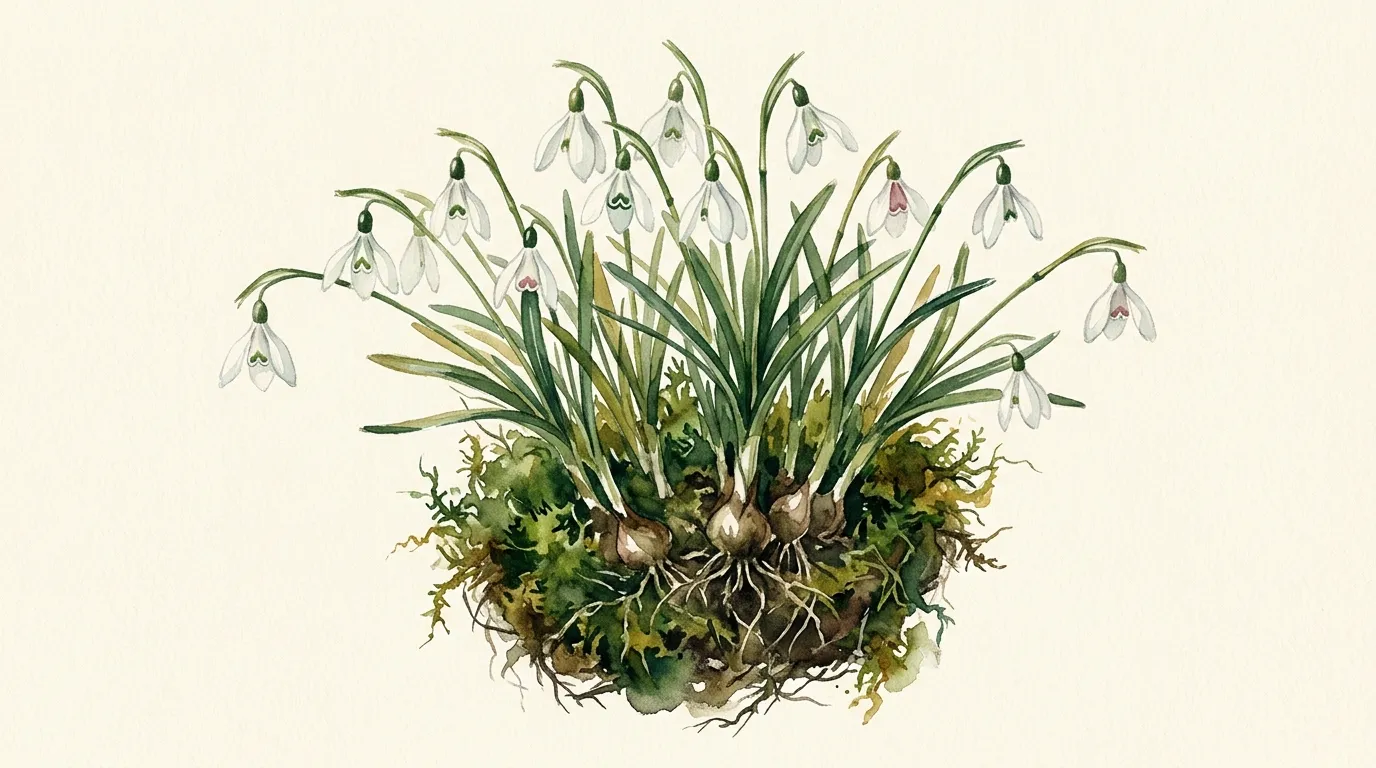
Snowdrop
Snowdrops: a flower to visit, not a flower to buy
Snowdrops are not sold as a cut flower in Ireland, and there are good reasons. What they mean, where to see them in February, and how to plant them properly.
Checked on
In season in Ireland
- January: in season
- February: in season
- March: out of season
- April: out of season
- May: out of season
- June: out of season
- July: out of season
- August: out of season
- September: out of season
- October: out of season
- November: out of season
- December: out of season
January to February
- Traditionally means
- Hope and consolation, the first flower of the year, though older British folklore treated a single snowdrop indoors as unlucky
- Vase life
- About 5 days
- Grown in Ireland
- No, imported
- Care in one line
- Buy them as growing bulbs in the green in February and plant them at once; a picked posy wants a cold room and a shot glass
- Botanical name
- Galanthus nivalis
Snowdrops are the flower nobody buys. The stems are ten centimetres long, the flowers last about five days in water, and there is no cut crop of any scale in Ireland, Britain or the Netherlands. If you came here looking for somewhere to order them, the answer is that this is not a flower to be delivered.
What it is instead is a flower to go and look at, and a bulb to plant. Both of those happen in the same two weeks of February, which is the point of this page.
What snowdrops mean
Hope and consolation, and the meaning is as literal as the daffodil's: the snowdrop flowers in January when nothing else does, often through frost, and it means that the year has turned.
It is tied to the calendar in two ways. Candlemas on 2 February gave it the old name Candlemas bells, and the same date sits beside St Brigid's Day on 1 February, which in the Irish reckoning is the first day of spring. A snowdrop in flower on St Brigid's Day is the calendar and the ground agreeing with each other, which does not happen often here.
The opposite tradition is worth knowing about. In Victorian British and Irish folklore a single snowdrop brought indoors was a death token, on the reasoning that the flower grew in graveyards and hung its head like a shroud. That is documented superstition rather than a living belief, and it is not an Irish invention.
Season in Ireland
January and February, with the peak in the second half of February in most of the country and a little earlier in the mild south west. By mid-March they are over and the leaves are dying back.
Snowdrops are not Irish natives. They naturalised here from garden plantings over centuries and now carpet riverbanks, old estate woodland and hedge banks across the country, which is why they read as wild.
Several Irish gardens open specifically for them. Altamont in County Carlow holds one of the larger collections in the country and Primrose Hill in Lucan is the other name that comes up every February. Check opening arrangements before travelling, since snowdrop openings are short and weather-dependent by nature.
What to do instead of buying a bouquet
Plant them. February is when nurseries and garden centres sell snowdrops in the green: clumps lifted while still growing, leaves and all, sold in bundles or pots. Planted at the same depth they came out of the ground, in shade under a hedge or a deciduous tree, they establish far more reliably than the dry bulbs sold in autumn packets, which fail often enough to be a bad buy.
They then spread on their own for decades and cost nothing again. As a gift for a gardener in February it beats a delivered bouquet on every measure except immediacy.
Be aware that snowdrops have a collectors' market. Single bulbs of rare named cultivars change hands for three-figure sums between the enthusiasts who call themselves galanthophiles, and the differences between those and an ordinary Galanthus nivalis are invisible to nearly everyone. Buy the common one.
If you do pick some
A small posy from a garden clump is fine, and it is one of the nicest things to have on a February windowsill.
Pick rather than cut, taking the stem from as low as you can, and never lift or pick from a wild colony or a public planting. Keeping the clump intact matters more than a posy does.
Use a shot glass or an egg cup with 3cm of cold water. Change it daily. Keep them in the coldest room you have, because warmth finishes them in two days and cold buys you five.
They will not last long, and that is the whole character of the flower. For something that opens a few weeks later and lasts longer, daffodils are the next thing out of the ground.
Ordering snowdrop delivered in Ireland is a question of who reaches the address and by when, not of who stocks the stem: most services build to a style rather than to a single flower, so ask before you pay if it has to be this one.
Questions people ask
Can you buy snowdrops as cut flowers in Ireland?
Why is it unlucky to bring snowdrops into the house?
When should you plant snowdrops?
Are snowdrops poisonous?
Are snowdrops native to Ireland?
Read next
- Daffodils: Irish season, meaning and the sap problemDaffodil sap kills the other flowers in a mixed vase unless you condition them alone first. The Irish season, Daffodil Day, and the folk superstition.
- Tulips: season in Ireland, meaning and vase careTulips keep growing after you cut them, bend towards the light and hate deep water. The Irish season, what the colours mean, and how to keep them upright.
- Irish flowers in season: a month-by-month calendarWhat Irish growers genuinely cut in each month, January to December, in one table: snowdrops in January, peonies in June, dahlias to the first frost.